Marfa, Texas, sits on the high desert plateau of the Trans-Pecos with the kind of silence that makes you want to fill it with sound. It is where Rob Mazurek — cornetist, painter, composer of galactic suites and electro-acoustic reveries — now makes his home, a long way from the Chicago Underground workshops at the Green Mill where he first began shaping the sound language that would eventually find its way into a Massachusetts museum in 1970. That journey — Jersey City to Naperville to the Green Mill to São Paulo to Marfa — has produced an artist of unusual breadth, one whose music carries the weight of every room he has inhabited. At thirteen he heard Kind of Blue in school; at sixteen he tracked down Bitches Brew, Urban Bushmen, The Shape of Jazz to Come — buying them for their covers, keeping them for what was inside. That autodidactic promiscuity, that willingness to let Coltrane and Ornette and Morton Feldman coexist inside a single imagination, is the bedrock of everything Mazurek has made since. It is also, unexpectedly, the foundation on which Kelly Reichardt has built one of the most distinctive film scores of recent years.
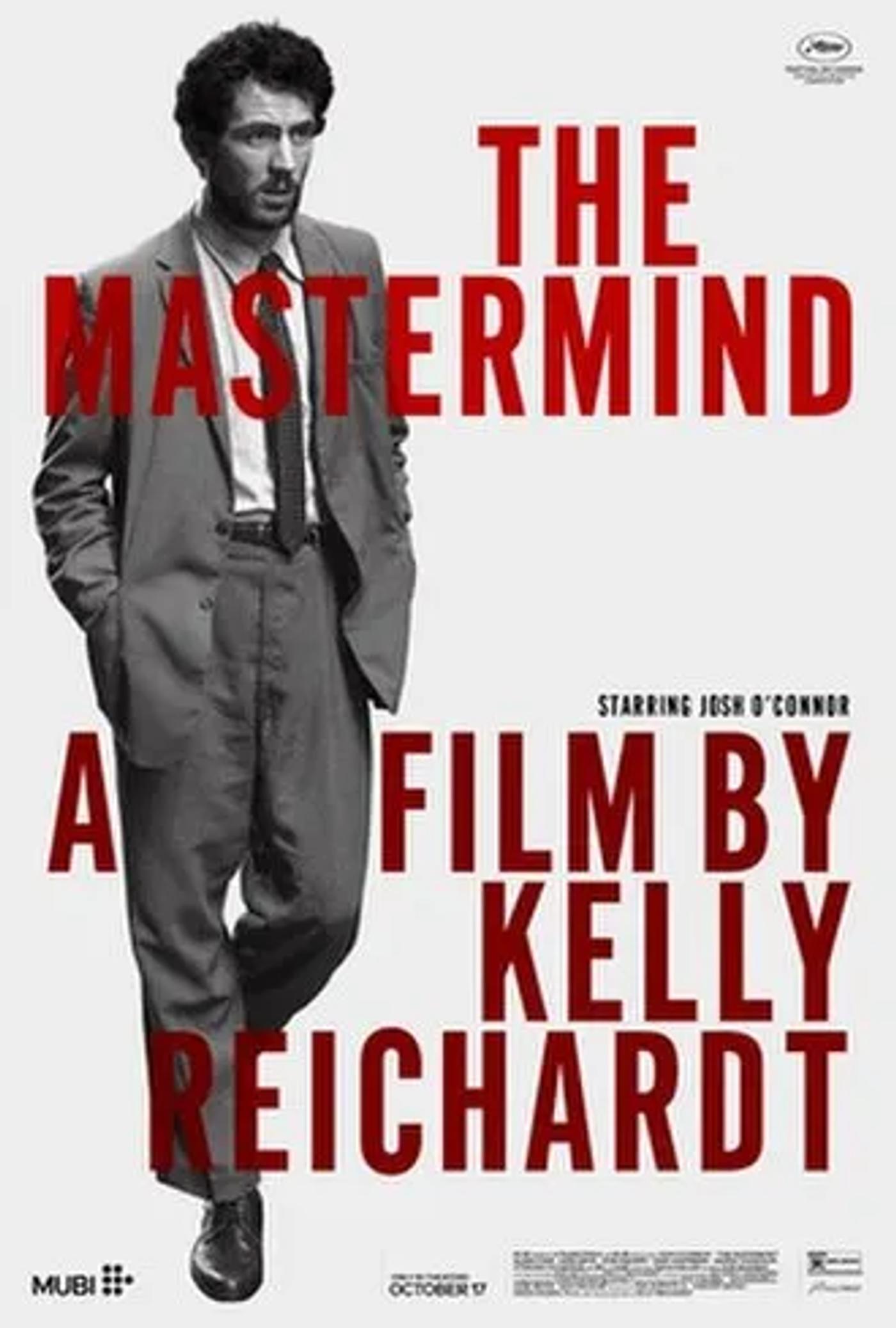
The clatter of cool jazz on the soundtrack announces The Mastermind like a calling card, the kind of score that back in the day would have heralded a maverick new talent. Which is odd, because Mazurek is emphatically not new — he has released more than fifty recordings across three decades — but this is his debut as a film composer, and what is remarkable is how fully formed it sounds, how sure of itself, how uninterested in the typical deferences of the film-score novice. Beneath the opening scene in the Framingham Art Museum, the score lends a mischievous tempo with a subtle bass line and brushes on cymbals that suggest something is afoot. But the mischief has a melancholy undertow. This is not the jazz of Playboy spreads and penthouse apartments. It is something more troubled, more porous — a music that knows its own limitations.
Mazurek has spoken of an early directive from Reichardt toward a Chet Baker quality, but with more edge — east coast Baker, is how he put it — and it is a frame that illuminates what the score is doing. Baker's genius was for a particular species of loneliness: the man with the chops and the profile who nevertheless could not quite hold his life together. JB Mooney, Josh O'Connor's unemployed carpenter turned amateur art thief, is cut from similar cloth — competent in the ways that don't seem to matter, incompetent in the ways that do. He acts at first with self-confidence, but the score's lone bluesy trumpet highlights his isolation and his lack of inner resources. The trumpet does not editorialize. It does not mock. It simply accompanies, and in that accompaniment it reveals.
Mazurek is joined by Chad Taylor on drums, his longtime partner in the Chicago Underground, alongside contributions from Mikel Patrick Avery, Victor Vieira-Branco, Joey Sullivan, and John Moran. Taylor's drumming is the score's secret engine. Where Mazurek's trumpet meditates, Taylor's kit moves — nervous, alert, always slightly ahead of the action onscreen, as if it knows where things are heading before JB does. As JB's heist proceeds, Mazurek adds vibraphone and a little jazz trumpet to deepen the intrigue factor, layering textures with the economy of a man who learned his trade in rooms where silence was as compositional as sound.
What Mazurek achieves, and what so few film composers manage, is a score that behaves like a character. The music is almost entirely restricted to scenes in which JB is thinking about or executing his master plan — which means its absences are as eloquent as its presences. When the jazz drops away and we are left with Reichardt's long, Hopperesque silences, the effect is exposure: JB standing in his borrowed life with nothing to cover him. Throughout the film, the score reminds us that JB isn't so much a mastermind as an improv artist, making things up as he goes. That is the great joke of the title, and the great sadness of it. Improvisation works when you have the musical intelligence to respond to what is actually happening. JB does not.
The jazz score mocks and questions what is happening, sometimes building up a frantic head of steam when nothing is occurring. This is Mazurek understanding something essential about Reichardt's cinema — that the gap between interiority and event is where her films live, that what a character feels and what actually happens are almost never the same thing. The score inhabits that gap. It plays the film JB thinks he is in while Reichardt shows us the one he is actually in.
There are moments where the score reaches a little too eagerly for convention — the skittering drum work and trumpet runs occasionally scream heist in progress in terms of conventional cinema language, and you can hear the ghost of a dozen cooler, more confident screen thieves haunting the mix. But this is perhaps intentional, another layer of Reichardt's ironising: the score that promises a Melville and delivers a pratfall.
What endures is the texture of the thing. Chicago Underground's sound — electro-acoustic, post-jazz, influenced by musique concrète and Afropop and Amazonian rainforest recordings and Ennio Morricone played on cornet — has been distilled here into something leaner, more functional, but no less itself. The twenty-five years Mazurek spent building that sound are audible in every phrase. This is what experience sounds like when it is used well: not displayed, but employed.
Place The Mastermind score alongside Chet Baker's Chet, alongside Dave Grusin's quieter work, alongside the jazz margins of Jonny Greenwood's film output, and Mazurek holds his own — not because he sounds like any of them, but because he has found something that sounds entirely like himself. That, in the end, is the only measure that matters.