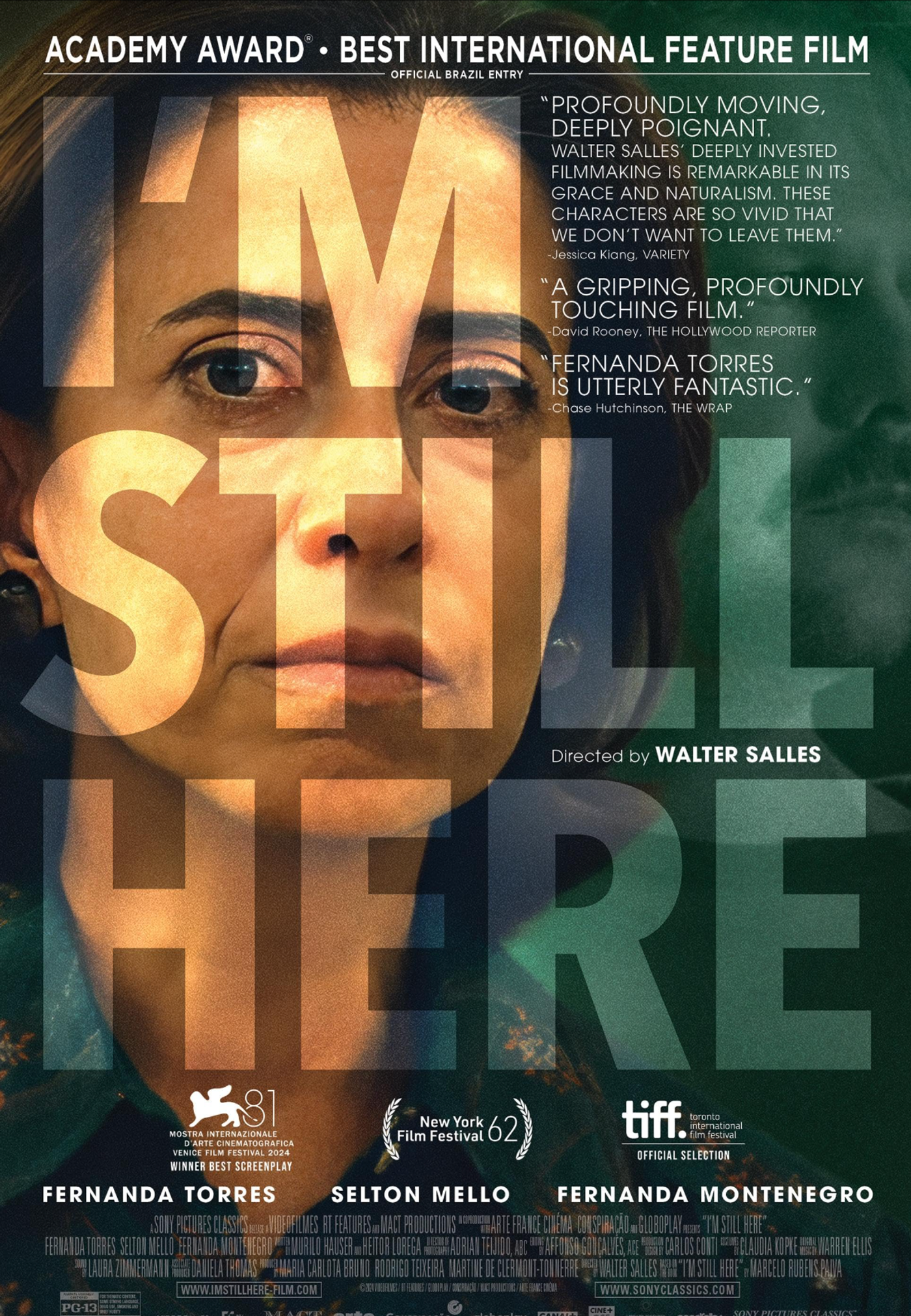
In 1971, Erasmo Carlos - Brazil's soft-rock heartthrob, half of the songwriting partnership that made Roberto Carlos a continental star, a man more associated with love songs than with politics - released É Preciso Dar Um Jeito, Meu Amigo. A gentle, urgent thing: a friend telling a friend that something has to change. It went out into a country where, that same year, the opposition politician Rubens Paiva was about to be taken from his Rio apartment by military agents and never seen again. Fifty-three years later, Walter Salles places that song inside the film about that disappearance, and the song does what no purpose-written cue could do. It carries the era as the era was actually heard - on the radio, in the kitchen, while the children played and the world continued.
This is the governing logic of the I'm Still Here soundtrack, and it is a quieter logic than it first appears. Salles uses canonical Brazilian music sparingly. Caetano Veloso and Gilberto Gil, the founders of Tropicália - both arrested and exiled under the same dictatorship the film depicts - drift through the Paiva household as records on a stereo, as voices on a radio, as the sound the eldest daughter Vera films her family by. They are not deployed as historical signposts. They are deployed as what they were: the everyday music of a particular Brazilian class in a particular year, which happens also to have been, by accident and design, the music of resistance.
Around and beneath these songs sits Warren Ellis's original score, which is one of the most disciplined things he has done. Ellis - the Dirty Three violinist who has spent twenty-five years building scores with Nick Cave for Andrew Dominik, the Coens, and David Michôd, music that tends toward the elegiac and the windswept - could easily have made I'm Still Here sound like a Cormac McCarthy adaptation. He doesn't. He pulls almost entirely back. Piano figures of three or four notes. Sustained strings held just below the audible. The score appears most often in the spaces between the Brazilian songs, and its work is to honour Eunice Paiva's interior life - the private grief that the public archive cannot record - without dramatising it.
The risk is that an Australian composer scoring a Brazilian historical trauma might feel, to a Brazilian audience, like the wrong passport in the room. The film's defence is that Ellis isn't asked to be Brazil. He's asked to be the silence around the songs, the unspoken weather of a family that has lost its centre. The Brazilian voices are already in the picture, doing their own work.
Placed beside Kleber Mendonça Filho's The Secret Agent, released the following year and set just six years later, the contrast is instructive. Mendonça Filho scores his dictatorship-era thriller as national memory at maximum density, dozens of needle-drops carrying a country. Salles scores his dictatorship-era family drama as one apartment, two or three records, and a foreigner's piano. Both films are right. I'm Still Here is the more intimate achievement - a soundtrack that understands that the music of catastrophe, while it is happening, is usually whatever was already playing.