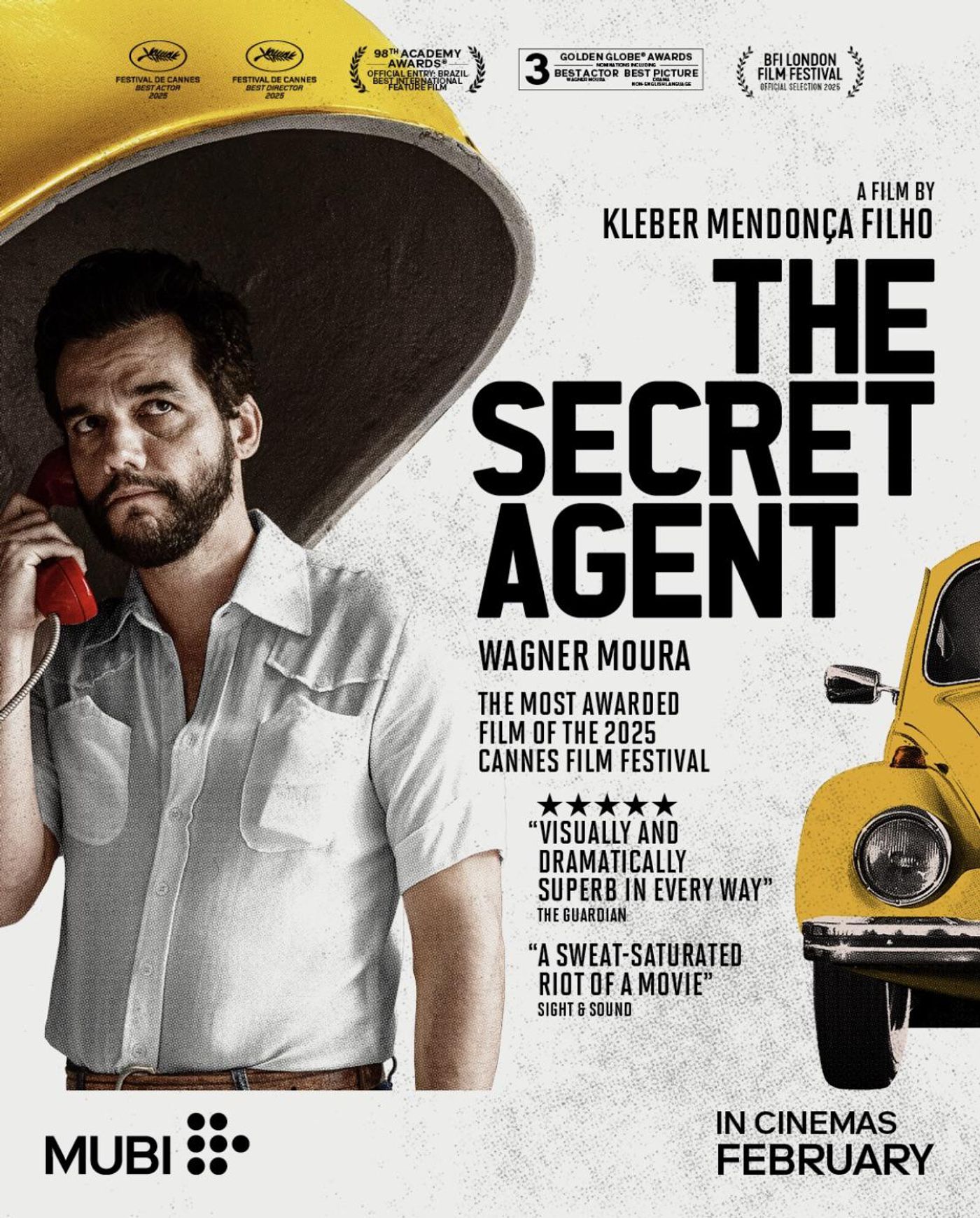
A severed leg, found inside a tiger shark hauled up at a Recife dock, becomes - through the particular witchcraft of this film's music supervision - the occasion for Ennio Morricone to drift in beneath the image, lifted from Guerra e Pace, Pollo e Brace, his sleazy-lyrical cue for a 1968 Italian sex comedy nobody now remembers. The joke is not the joke. The joke is that 1977 Recife, under thirteen years of military dictatorship and a state-sanctioned carnival of disappearances, is being scored as though it already knew it was a seventies film - as though the people inside the picture were watching themselves from the future and choosing the records.
That is the governing instinct of Mendonça Filho's soundtrack, and one of the most sustained acts of curated remembering in any film of the past decade. The original score, by Mateus Alves and Tomaz Alves Souza - returning from Bacurau - works mostly as connective tissue: warm analogue synth pads, faintly threadbare strings, the kind of cues that know better than to compete with what surrounds them. Their restraint is the price of entry. What flows over them is the deeper archive - MPB deep cuts and regional music drawn from a tradition most Anglophone listeners will not know. Música Popular Brasileira, MPB, is the broad umbrella for the sophisticated, often politically watchful songwriting that came up in Brazil from the mid-1960s - bossa nova, samba and Northeastern regional music absorbing rock and the avant-garde. Mendonça Filho reaches not for its famous names but for its harder-to-find shelves: Lula Cortês and Zé Ramalho's Paêbirú, a 1975 Pernambuco psych-folk-mysticism double album that flopped, was destroyed in a warehouse flood, and became cult treasure thirty years later; Ângela Maria, the bolero-trained mid-century voice of an older Brazil; Waldick Soriano singing what amounts to the cabaret of national humiliation; Orquestra Nelson Ferreira, the Recife composer who codified Northeastern carnival music in the 1930s; and the Banda de Pífanos de Caruaru, whose cane-fife tradition is older than any of this and outlives all of it. International intruders - Chicago, Donna Summer - are deployed less as nostalgia than as evidence: this was the music coming through the radio at the safe house, and it is dancing while people are being taken.
The work the soundtrack does is harder than period accuracy. Period accuracy is a checklist. What Mendonça Filho and his team accomplish is something closer to seance - letting the music of the Northeast speak in the registers it actually contained in 1977: the official broadcast, the underground LP, the carnival street, the bolero on a kitchen radio, the foreign record that arrived three months late. Every needle-drop in The Secret Agent is a small act of historical refusal: a song the dictatorship could not erase, set against the silences it imposed.
If there is a strain it is in the genre-cinema knowingness - the Morricone cue, Belmondo borrowings, clips of Jaws and The Omen breathing through the mix. Some of this lands as wit, some as winking, and the film is just self-aware enough to risk turning its own grief into pastiche. It is the cost of the method. The reward is that almost no contemporary soundtrack has trusted music to carry national memory at this density.
Mendonça Filho has used music heavily in every film he has made, but never quite like this. In Aquarius (2016), the soundtrack was the record collection of a single Recife apartment - one woman's life heard through her own stereo. In Bacurau (2019), co-directed with Juliano Dornelles, music became genre weaponry: Brazilian regional cuts colliding with John Carpenter, psych-rock, dub, all of it rougher and more confrontational. The Secret Agent is the scaling-up. The same instinct that placed records inside one apartment now reaches across an entire country and an entire decade - a soundtrack as archive, as séance, and as quiet revenge.