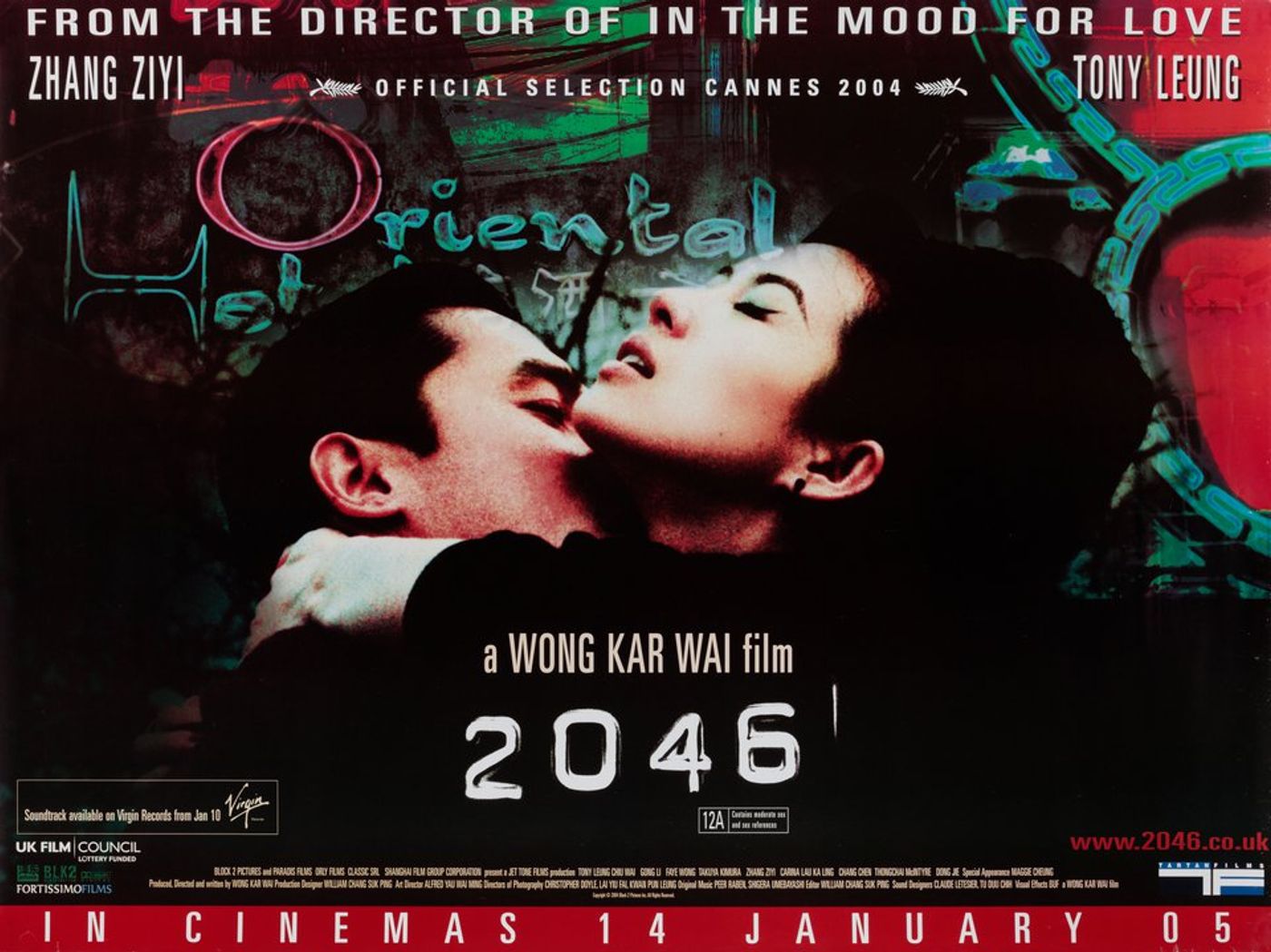
When the first sustained piece of score arrives in 2046, it is not the work of a Hong Kong composer or even a Chinese one. It is "Dark Chariot," a piece written by Peer Raben for Rainer Werner Fassbinder's Querelle in 1982 - a German film, adapted from Jean Genet, about a homosexual sailor in a French port. Wong lifts it intact, drops it into a 1960s Hong Kong hotel corridor, and lets it run. A few scenes later, he does it again with "Sisyphos at Work," another Raben cue, this one from Fassbinder's The Third Generation (1979). Raben was Fassbinder's lifelong house composer, a master of Weimar cabaret melancholy and operatic queer melodrama. To find his music inside a Wong Kar-wai film is to understand, in a single needle-drop, what Wong is actually doing: making a film about the impossibility of romantic recovery, and reaching across forty years and two continents to find the existing music that already knows that subject by heart.
This is the governing logic of 2046. The film's nominal composer, Japanese veteran Shigeru Umebayashi, returns from his career-defining In the Mood for Love work to write a main theme that recurs across the picture in cycling variations - rumba version, percussion version, a "train remix" that closes the film. Wong's own description of his method is more candid than most directorial statements: musical excerpts, he says, "appear in cycles, as in remembering and forgetting." The Umebayashi theme is the gravitational centre, but everything else - the Bellini Casta Diva from Norma, Georges Delerue's "Julien et Barbara" from Truffaut's Vivement Dimanche!, Zbigniew Preisner's "Decision" from Kieślowski's A Short Film About Killing, Xavier Cugat's Cuban dance numbers, Connie Francis singing "Siboney," Nat King Cole crooning "The Christmas Song" - is a curated assembly of music about elsewhere. Hong Kong, 1966-69, scored as a city of imported feelings.
The one tradition almost entirely missing is Chinese popular music. There is no Cantopop here, no Mandarin standards from the period the film depicts. The omission cannot be accidental; Wong knows that archive better than almost any living director. What he is staging instead is the inner life of a Hong Kong writer (Tony Leung's Chow Mo-wan) who lives mentally inside foreign records - the colonial city's cosmopolitan ear, the lover who would rather listen to Bellini than to anything from home. The soundtrack is a portrait of a sensibility, not of a place.
The risk of this method is preciousness - a soundtrack that congratulates itself on its references. 2046 sometimes flirts with it; the Bellini cue, in particular, can feel insistent on its own weight. But the Raben transplants are the masterstroke. They prove that Wong is not curating to display taste. He is curating to find the music that has already done his grieving for him.
Placed beside In the Mood for Love - that more famously single-themed soundtrack, the Umebayashi waltz on a loop - 2046 is the wider, sadder, more borrowing film. The compulsively returning Yumeji's Theme of 2000 has become a whole library of returns. Memory, it turns out, has many soundtracks.