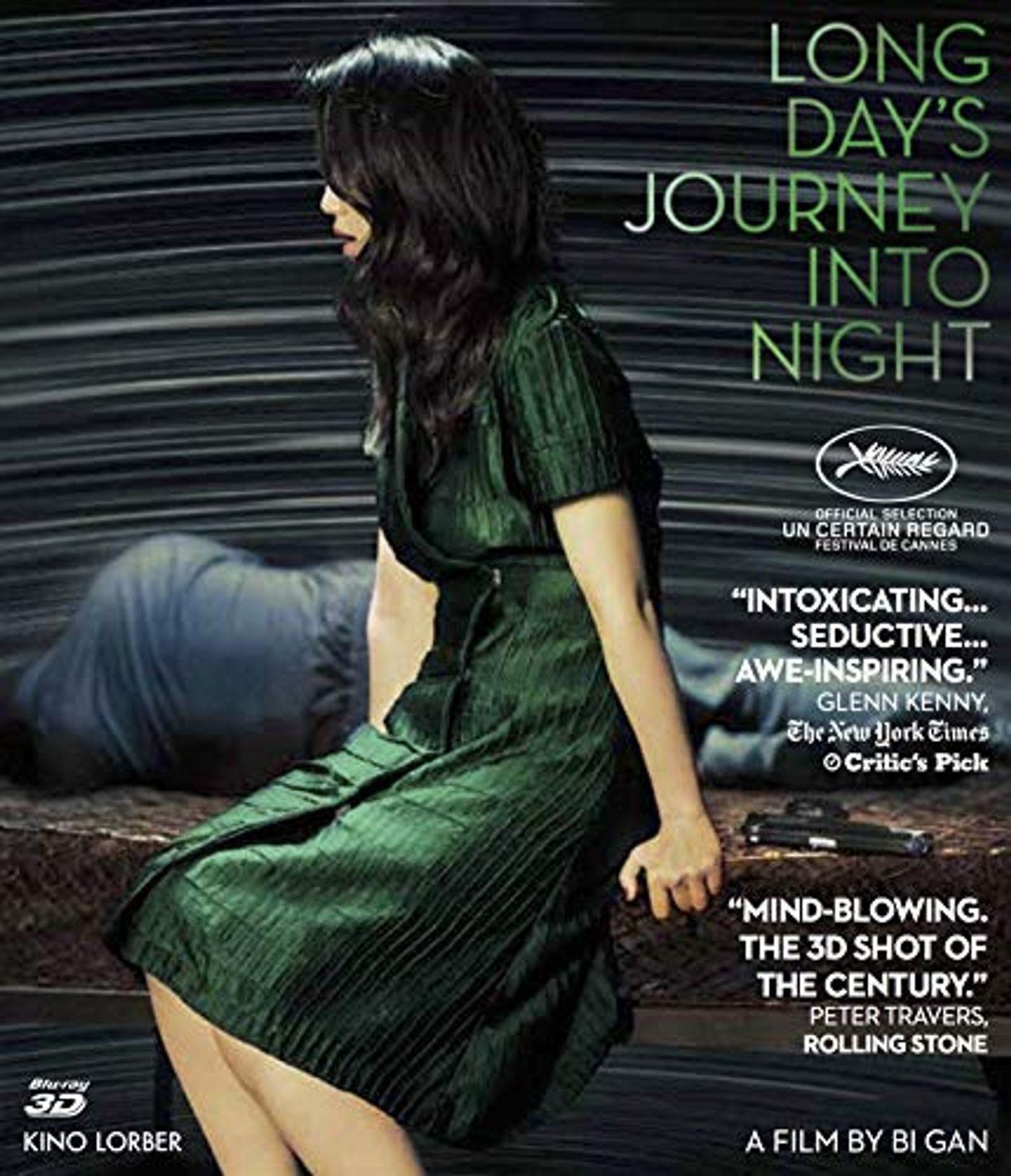
Seventy minutes into Long Day's Journey Into Night, the title card finally appears, the protagonist walks into a dingy provincial cinema, puts on a pair of 3D glasses, and the film does the same. A 2D noir about memory becomes a 3D continuous take that will run, unbroken, for the next fifty-nine minutes. It is one of the most audacious structural gestures in twenty-first-century cinema. And the only thing holding it together - the only element that bridges those two halves so the cut does not register as gimmick but as the dissolve from waking into dream - is the score. Lim Giong and his collaborator Chih-Yuan Hsu (sometimes credited as Point Hsu) do not announce the transition with a swell or a motif. They let the music thin. Synthesizers spread. The string halo widens. The pressure that has been quietly accumulating beneath the 2D first half releases into something almost weightless, and the audience floats with it.
That this works at all is a function of where Lim Giong learned to score films. In 1990 he released his debut album, Marching Forward, singing in Taiwanese Minnan rather than the Mandarin of mainstream Sinosphere pop - one of the founding documents of what was then called the New Taiwanese Song movement, an island reclaiming its own ear. Three years later he went to England, came back transformed by drum and bass and ambient electronics, and by the late nineties had become the regular composer for Hou Hsiao-hsien, the slow-cinema master whose Millennium Mambo, Three Times and The Assassin depend on Lim Giong's pulsing, near-still electronic textures the way breath depends on lungs. The journey from village-square folk singer to Hou's house composer is one of the most extraordinary careers in East Asian film music. It is also, by 2018, the discipline that allows him to score Bi Gan's 2D-to-3D dissolve without ever raising his voice.
Bi Gan - born in Guizhou in 1989, the most exciting young director working in the slow-cinema tradition Hou helped invent - gets from Lim Giong what Hou himself gets: small electronic gestures, sustained tones that behave like weather rather than melody, the occasional plaintive piano figure that arrives like a memory of a song rather than the song itself. In the 2D half, the score thickens around the flooded rooms and pool halls of provincial Guizhou - those wet, peeling interiors that Bi Gan inherits from Tsai Ming-liang. By the time the 3D begins, the music has prepared the ear so completely that the eye barely registers the shift.
The risk of this kind of scoring is that ambient restraint can shade into ambient absence - the listener stops noticing the music is there. Long Day's Journey occasionally crosses that line; there are stretches, particularly in the film's middle, where the score is so reticent it almost disappears. Whether this is failure or fidelity to the material is the unresolvable question of all Hou-tradition scoring, and Lim Giong has earned the benefit of the doubt over a quarter-century of it.
Placed beside his own work for Hou's The Assassin - that wuxia film of imperial stillness - Long Day's Journey Into Night is the moment Lim Giong's vocabulary passes into a younger director's hands. The hush is intact. What it is being asked to hold is something newer.