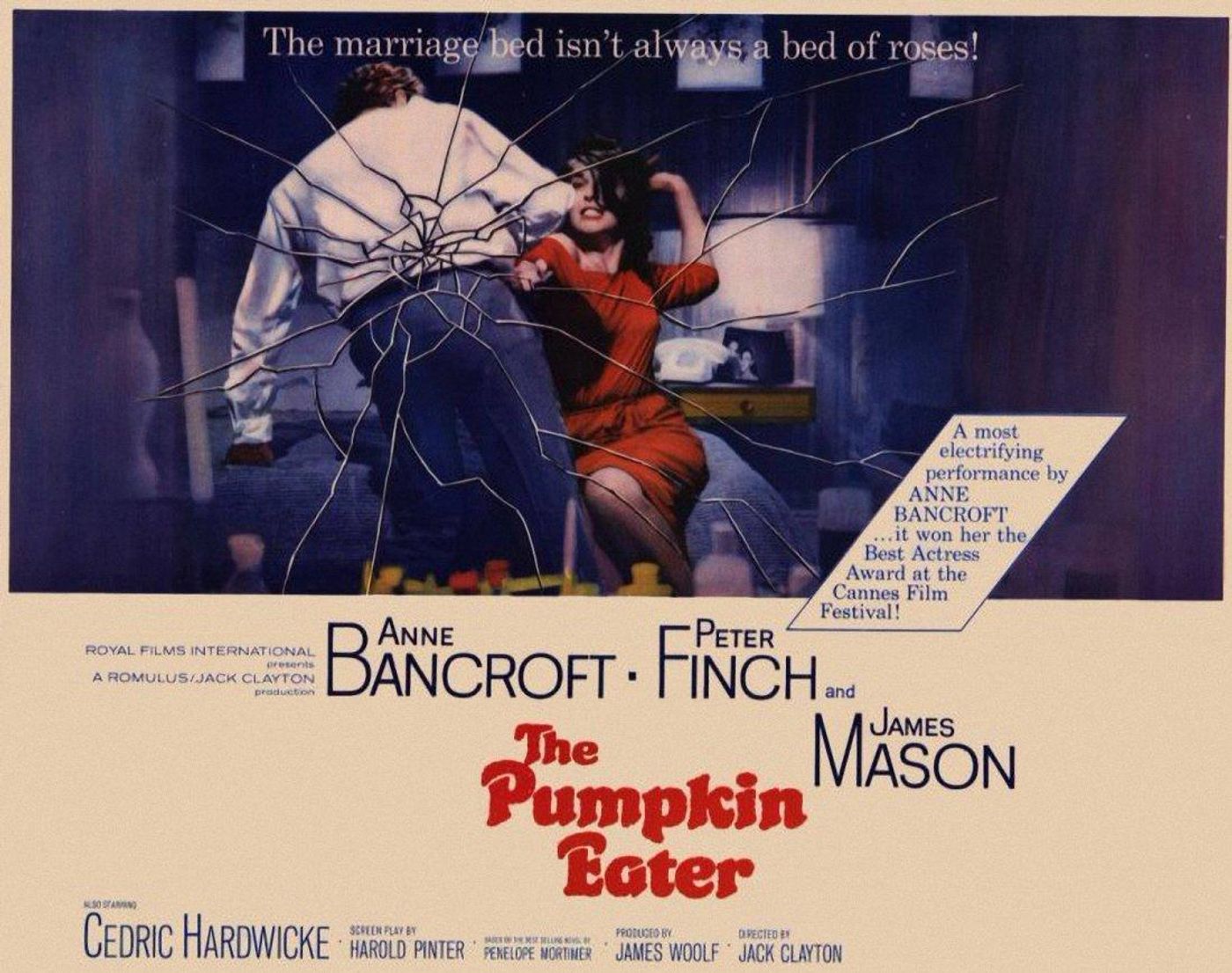
London in the early 1960s, and two kinds of film are being made simultaneously on the same streets without quite acknowledging each other. The first is the British New Wave — kitchen sinks, back-to-backs, the angry young men of Salford and Sheffield claiming the screen for the working class, their grit and frustration captured in the harsh black-and-white photography that Karel Reisz and Tony Richardson had learned to treat as its own kind of beauty. The second is something different in register if not always in subject: the interior film, the film of women's psychology, the film that asks not what the class system does to men but what the institution of marriage does to women. Jack Clayton was the director who most consistently occupied this second territory, and The Pumpkin Eater — his 1964 adaptation of Penelope Mortimer's semi-autobiographical novel, scripted by Harold Pinter in what Pinter himself would later describe as the best working year of his life — is its exemplary document.
Georges Delerue came to this material from the other side of the Channel, trailing the perfume of the French New Wave behind him. He had scored Godard's Le Mépris the year before, had been Truffaut's composer from Shoot the Piano Player onward, had absorbed from Alain Resnais the idea that a film score could do something other than illustrate emotion — that it might instead create the precise quality of atmosphere inside which emotion becomes possible. When Clayton recruited him for The Pumpkin Eater, it was the beginning of a partnership that would continue across five films and nearly thirty years, and that would prove, in its first flowering, as productive as any director-composer collaboration in British cinema of the period.
What Delerue understood, and what makes the score so quietly extraordinary, is that Penelope Mortimer's subject — the inner dissolution of a woman named Jo, living inside a prosperous London marriage to a philandering screenwriter, surrounded by children who represent both her anchor and her entrapment — is not a subject that admits orchestral amplitude. The music Bernard Herrmann might have brought to this material would have beaten it into submission. What the film needed instead was something closer to what the New York Times would later say of Delerue's work more generally: a shimmering atmospheric quality that recalls Debussy, and other effects that evoke Satie. These are not composers who explain emotion. They are composers who create the conditions for it to occur.
Oswald Morris's cinematography — the extreme close-ups of Anne Bancroft's face, the way the frame slowly crops her as Peter Finch leans over her to explain why she must have an abortion — already does the work of distress. Delerue's score doesn't comment on that distress. It inhabits the same space around it, like air in a room where something terrible has been said. The main theme, when it appears, has the quality of something half-remembered rather than fully stated — melodic in Delerue's characteristic way, but held at the edge of completion, as if the resolution has been quietly removed. This is the appropriate musical form for Pinter's screenplay, which is itself built around what is not said, the gap between the words and the feeling, the pause that carries more weight than anything spoken.
The film sits at an interesting junction in British cultural history: Mortimer's novel appeared in 1962 and drew directly on her own six children, multiple marriages and personal experience of abortion and sterilisation; Pinter, whose BAFTA-winning adaptation was his first feature screenplay from another writer's work, brought to it the techniques he had developed in stage plays that were explicitly about the failure of language to reach across the distance between people. Clayton, who had already proved with The Innocents that psychological interiority was his deepest interest as a director, assembled around this material a cast — Bancroft, Peter Finch, James Mason, a young Maggie Smith — who understood what was being asked of them. That Delerue's score is rarely discussed in the same breath as these collaborators is partly a matter of the film's own strange obscurity: praised at Cannes, Oscar-nominated, then half-forgotten, the film shared with its source material the quality its subject notices about herself — present everywhere, fully visible, inexplicably unseen.
There is a moment towards the film's end, when Jo stands alone in the windmill that she and Jake have been renovating, a building that has accumulated through the narrative the weight of everything they might have been to each other, and the morning light comes in through the sails. Delerue's music enters here not as resolution but as a kind of open question held in suspension. It is the sound of someone arriving at a position that is not happiness and not despair but something between them — the particular quality of a life going on after it has been rearranged by damage, the way that certain things persist even after the conditions for them have been removed. It is, in its way, the musical equivalent of what Mortimer said she tried to put into her novel: practically everything she could say about men and women and their relationship to one another.
Delerue died in 1992, hours after recording the final cue for his last film, as if he had arranged it that way. He left behind 350 scores, most of them heard the once and not again, living on as atmosphere inside films that contain them. The Pumpkin Eater is one of the few cases where the score outlasts its occasion: where the music does not merely accompany the images but provides the emotional register without which the images would be, in their cold and clinical intelligence, slightly less than human.