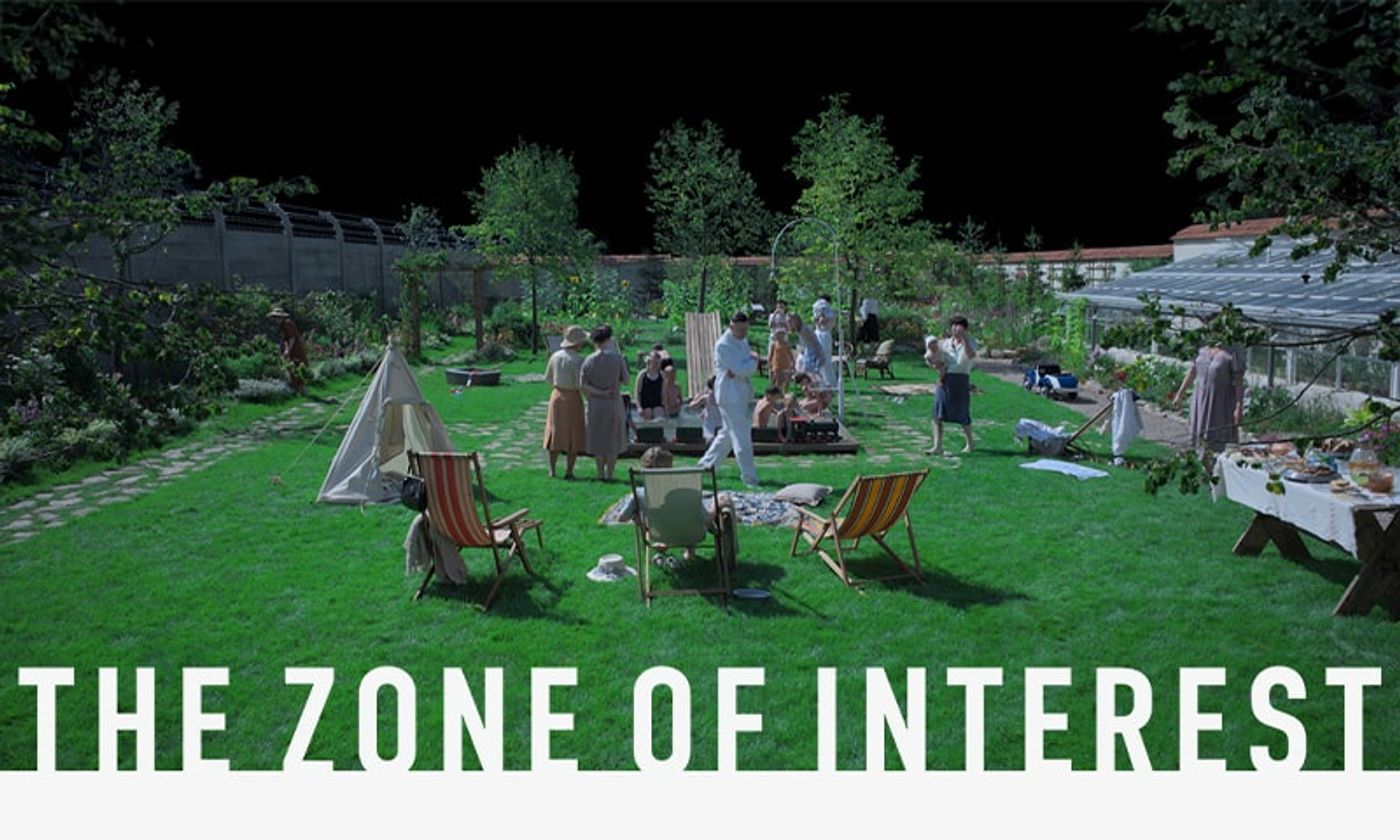
For the first two and a half minutes of The Zone of Interest, there is no film. The screen is black, and from inside the black a cloud of voices and synthesizers forms, drifts together into something almost choral, then begins to slide downward in pitch — not resolving, not arriving anywhere, just descending like a body falling through dark water. When the image finally comes it is a family picnic on a Polish riverbank in high summer, and the music is already gone. The soundtrack has handed you over to the film. It will not come back properly, at full strength, until the end credits, when those same voices return as screams.
Everything you need to know about Mica Levi's score is in that descent. It is fourteen minutes of music across a 105-minute film, which is to say almost no score at all — an overture and an end-title threnody with a handful of short stabs scattered in between, most of them placed over thermal-camera sequences of a Polish girl leaving apples for starving prisoners. A different composer would have filled the picture with emotion, given the audience somewhere to put their feelings. Levi refuses this almost completely, and the refusal is the work. The sounds they do provide — what Levi calls the "yums," deep robotic swallowing noises that appear under the thermal scenes like gut-weather — are designed not to guide the viewer but to disturb them, to make the film's surface of domestic contentment vibrate with a sickness that the image itself will not admit.
Levi was born Micaela Rachel Levi in 1987, raised in Watford, trained on the violin from the age of four, then scholarship-winner at the Purcell School and composition student at the Guildhall, where they dropped out when their experimental pop band Micachu and the Shapes — half-guitars, vacuum cleaners, found objects, Aphex-adjacent pop — unexpectedly took off. Their father, Erik Levi, is a pianist and one of the leading British scholars of music in the Third Reich. Their grandfather was a German-Jewish violinist who escaped the Nazis and made his way to the United Kingdom. That is not biography as local colour. That is the lineage that makes Levi the only composer in Europe who could have written a fourteen-minute score for this film and understood, at the level of inherited memory, that its work was to hold the listener at the correct distance from a place their own family had to run from.
The more consequential half of the soundtrack, though, is not by Levi at all. It is by Johnnie Burn. Burn has worked with Jonathan Glazer for more than two decades — Guinness adverts, Birth, Under the Skin — and has increasingly come to function as something other than a sound designer in the conventional sense. For The Zone of Interest he was handed the script a year before shooting and told that sound, not image, would have to carry the death camp. What Burn did with that year would ordinarily be called research; in this case it became a kind of auditory scholarship, almost a second Holocaust archive. He compiled a 600-page document of what Auschwitz might have sounded like in 1943, cross-referenced against survivor testimony, the Auschwitz-Birkenau Museum records, Primo Levi. He went to a firing range on the Isle of Wight because its building acoustics approximated the reverb signature of the camp's Block 11, and recorded period-correct First World War rifles (the guards at Auschwitz used old weapons, not the frontline ones) from a hundred and fifty metres away, the distance between the Höss garden and the execution wall. He recorded pension-reform rioters in Paris to get French-accented distress; he recorded rural lower-league German football crowds to get young men shouting aggressively in the right vowels. He built a sound of the crematorium out of flames and fans and tubes in his own fireplace in Brighton, then layered it until it became what the film calls, in its most audible piece of horror, the rumble. Which is in the film always, and which you gradually realise is not sound design at all but the respiratory system of industrial murder, heard from the wrong side of a garden wall.
So the soundtrack of The Zone of Interest is two things that almost never touch. There is Levi's small, bracketing chorus — a threshold at the start and a shriek at the end, with thin filaments of unease in between. And there is Burn's continuous, granular layer of the camp itself, which is not music and does not pretend to be. Between them, for ninety minutes, is something like silence — the breathing of Rudolf and Hedwig Höss, their children drumming, the summer garden, a mother-in-law's tea cup — the sonic furniture of a middle-class domestic life, meticulously captured on twenty hidden microphones with three-quarters of a mile of cable strung through the ceilings of a recreated house. The achievement of the soundtrack is precisely that it refuses to score what cannot be scored. The film's most radical decision is to let the sound of the camp be present without being performed.
If there is a criticism to make it is of the end-title sequence — six minutes of ascending screams, over black, from a group of trained singers. It is overwhelming in the cinema, which is its intention, but it is also the only moment in the film where the restraint slips and the work reaches for catharsis. It is not a betrayal, exactly; it is the permission Glazer and Levi give themselves to stop holding the line. But it trades a little of the film's extraordinary ethical coolness for an emotional release that the previous ninety minutes were explicitly engineered to deny. One can be grateful for the release and still notice that the grammar has shifted.
Placed alongside the canon of serious twenty-first-century film scoring for subjects that should not permit music — Jonny Greenwood's barbed, almost antagonistic work for There Will Be Blood; Wojciech Kilar's hymns inside The Pianist; Hans Zimmer's clock-pulse in Dunkirk; Levi's own sinewing for Under the Skin — the Zone of Interest soundtrack sits in the most austere corner. It is the rare piece of film music that has understood that its first duty may be to get out of the way. What Levi and Burn have made, between them, is less a score than a moral apparatus: a way of making a listener complicit in what they hear without permitting them to turn it into an experience.